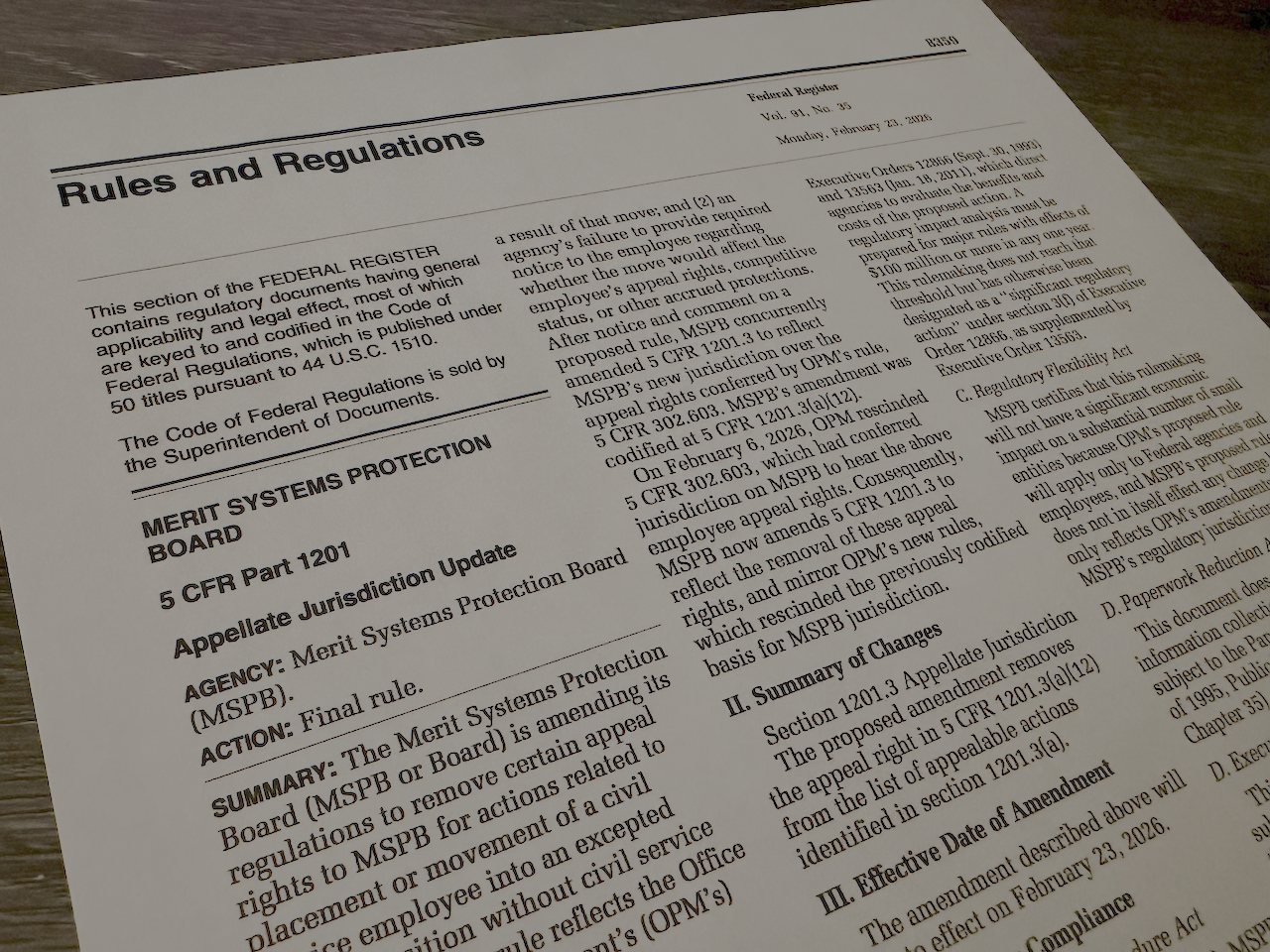
Today, the federal government published 147 documents in the Federal Register. There were proposed rules on everything from offshore blowout preventer reporting requirements to employment authorization reform for asylum applicants and final rules on the Farmer Bridge Assistance Program and to increase the 2026 mackerel fishery specifications.
This happens every business day. In 2025, the government published 23,690 Federal Register documents. In 2024, it was 30,830.
Yet most Americans, and many professionals who are directly affected by these documents, have never read the Federal Register or even know what it is.
This guide explains what the Federal Register is, what gets published in it, how it’s organized, and why anyone working in government affairs, regulatory compliance, or law needs to understand it.
What Is the Federal Register?
The Federal Register is the official daily journal of the United States federal government. Published every business day by the Office of the Federal Register, it is the legal vehicle through which federal agencies communicate with the public. Proposed regulations, final rules, public notices, and presidential executive orders are published in the Federal Register before they can take legal effect.
Congress established the Federal Register through the Federal Register Act, ch. 417, 49 Stat. 500 (1935) (codified as amended at 44 U.S.C. §§ 1501–1511). The first issue was published on March 14, 1936. The publication is administered by the Office of the Federal Register (OFR), a component of the National Archives and Records Administration (NARA), in partnership with the Government Publishing Office (GPO).
New issues of the Federal Register are published Monday through Friday, except on federal holidays, and it is available free online in two forms: federalregister.gov, the modern, searchable version maintained by the OFR, and govinfo.gov, the official GPO repository that hosts the authenticated PDF editions. The print edition still exists with an average page count of 80,000 pages each year over the past 10 years—ranging from a low of 61,584 pages in 2025 to a high of 107,261 pages in 2024.
If you think of the Federal Register as the government’s daily newspaper for regulations, you are not far off. It is the single place where agencies are legally required to publish their actions before those actions can bind the public.
Regulation Roundup tracks nearly 991,000 Federal Register documents dating back to 1994 — searchable by agency, document type, keyword, and significance level.
The Four Types of Federal Register Documents
Every document published in the Federal Register falls into one of four categories. Here is what each one means, with 2025 volume data to show the scale.
1. Rules (Final Rules)
Final rules are legally binding regulations that have completed the rulemaking process. Once published in the Federal Register, they carry the force of law. This category includes direct final rules, interim final rules, and corrections to previously published rules.
In 2025, the government published 2,441 final rules — about 10.3% of all Federal Register documents. An example: when the EPA finalized its repeal of all federal greenhouse-gas emission standards for new motor vehicles and engines, that final rule was published in the Federal Register with an effective date of April 20, 2026.
2. Proposed Rules
Proposed rules are draft regulations that agencies are considering but have not yet finalized. Agencies publish proposed rules to invite public comment, which is where the public gets a voice in the regulatory process.
In 2025, the government published 1,498 proposed rules — about 6.3% of all Federal Register documents. Comment periods typically last 30 to 90 days. During that window, anyone, including individuals, businesses, trade associations, and other government agencies, can submit written comments on the proposal.
3. Notices
Notices are the largest category by far. They include meeting announcements, policy guidance documents, grant availability announcements, petition responses, environmental impact statements, and other agency communications that do not fit neatly into the rulemaking categories. Not all notices carry regulatory weight, but many are legally significant.
In 2025, the government published 19,280 notices — a staggering 81.4% of all Federal Register documents. Examples include Sunshine Act meeting notices (required when certain federal boards meet in public), FACA advisory committee announcements, and environmental impact statements under NEPA.
4. Presidential Documents
Presidential documents include executive orders, presidential memoranda, proclamations, and other directives issued by the White House. These are published under the authority of the President and do not go through the notice-and-comment rulemaking process that applies to agency rules.
In 2025, the government published 471 presidential documents — about 2% of all Federal Register documents. Today’s edition includes an executive order on elemental phosphorus and glyphosate-based herbicides under the Defense Production Act (E.O. 14,387). Another recent example is the February 13, 2026 executive proclamation “Ensuring Affordable Beef for the American Consumer.”
2025 Federal Register breakdown: Notices (81.4%), Rules (10.3%), Proposed Rules (6.3%), Presidential Documents (2.0%)
Which Agencies Publish the Most?
Not all agencies contribute equally. Here are the top 10 federal agencies by Federal Register publishing volume in 2025:
| # | Agency | 2025 Docs |
|---|---|---|
| 1 | Health and Human Services (HHS) | 2,634 |
| 2 | Securities and Exchange Commission (SEC) | 2,314 |
| 3 | Transportation Department (DOT) | 2,222 |
| 4 | Commerce Department (DOC) | 2,221 |
| 5 | Energy Department (DOE) | 1,749 |
| 6 | Interior Department (DOI) | 1,561 |
| 7 | Homeland Security (DHS) | 1,051 |
| 8 | Environmental Protection Agency (EPA) | 892 |
| 9 | Justice Department (DOJ) | 727 |
| 10 | Treasury Department | 719 |
HHS leads the pack because its sub-agencies (e.g., CMS, FDA, and CDC) each publish heavily across rules, proposed rules, and notices. The SEC’s high volume is driven mostly by notices: filing acknowledgments, self-regulatory organization rule changes, and other administrative communications that are required to go through the Federal Register.
The Transportation Department’s volume is largely a product of FAA airworthiness directives, which are safety corrections issued for specific aircraft models that are published as individual rules.
It is worth noting that independent agencies like the SEC, FCC, and FERC publish in the Federal Register but, until recently, were not subject to review by the Office of Information and Regulatory Affairs (OIRA) before their rules were published (see E.O. 14,215). That distinction matters for understanding how regulation is actually made — a topic we will cover in a future post on OIRA.
On Regulation Roundup, you can filter Federal Register documents by agency, document type, significance level, and date range — and set alerts for specific agencies or topics.
Federal Register vs. CFR: What’s the Difference?
This is one of the most common points of confusion in regulatory work, so let’s clear it up.
Think of the Federal Register as the government’s newspaper and the Code of Federal Regulations as its encyclopedia.
The Federal Register publishes new and proposed regulations as they happen, in chronological order. The Code of Federal Regulations (CFR) compiles all currently in-effect regulations, organized by subject area into 50 titles.
When a final rule is published in the Federal Register, it eventually gets codified by incorporation into the relevant title and section of the CFR. The Federal Register entry tells you when a regulation was created and why (through the preamble). The CFR tells you what the law currently says.
Here is a quick reference:
| Federal Register | Code of Federal Regulations | |
|---|---|---|
| What it is | Daily journal | Codified regulations |
| Published | Every business day | Updated annually (rolling) |
| Organization | Chronological | By subject (50 titles) |
| Contains | New rules, proposed rules, notices, presidential docs | All current regulations |
| Analogy | The newspaper | The encyclopedia |
If you need to know whether a regulation exists and what it currently says, check the CFR. If you need to know when it was created, why the agency wrote it that way, what comments were received, or what changes are coming next, check the Federal Register.
How to Read a Federal Register Document
Federal Register documents follow a standardized format. Once you know the structure, you can quickly find what matters. Here are the key sections, in the order they appear:
- Header block — The agency name, the CFR part(s) affected, the RIN (Regulatory Identification Number) if applicable, and the document type. This tells you at a glance which agency is acting and what part of the regulatory code is involved.
- AGENCY — The specific sub-agency responsible for the document. For example, a rule from HHS might come from CMS, FDA, or CDC.
- ACTION — A one-line description of what this document is: “Proposed rule,” “Final rule,” “Notice,” “Request for comments,” etc.
- SUMMARY — A plain-language description of what the document does. This is the single most useful section for deciding whether a document is relevant to you. Start here.
- DATES — The effective date for final rules or the comment deadline for proposed rules. This is the section that tells you when you need to act.
- ADDRESSES — Where to submit public comments, usually a link to the docket on Regulations.gov.
- FOR FURTHER INFORMATION CONTACT — The name, phone number, and email of the actual person at the agency who can answer questions about the document.
- SUPPLEMENTARY INFORMATION — The full preamble. This is the longest section and the most important for practitioners. It explains the rule’s background, the agency’s legal authority, its reasoning, and its responses to public comments received during the proposed rule stage.
- Regulatory text — The actual regulatory language being added, modified, or removed in the CFR. This is what will be codified.
Pro tip: Most practitioners skip straight to the SUMMARY and DATES sections first. If a rule affects your industry, read the SUPPLEMENTARY INFORMATION carefully — that is where the agency explains its reasoning and responds to public comments. This section is critical for understanding how to comment effectively on future rules and for building the record in potential legal challenges.
Why Should You Care About the Federal Register?
The Federal Register matters to different professionals for different reasons:
Government affairs professionals rely on the Federal Register to learn about upcoming regulations before they become law. A proposed rule published in the FR opens a comment window of typically 30 to 90 days during which your organization can submit formal input. Missing a proposed rule means missing your chance to shape the final regulation.
Regulatory attorneys use FR preambles as the foundation for judicial review under the Administrative Procedure Act. The “arbitrary and capricious” standard that courts apply often turns on what the agency said or failed to say in the Federal Register preamble. If the agency did not adequately respond to a significant comment, that omission can be grounds for a legal challenge.
Compliance officers need the Federal Register to track effective dates and compliance deadlines. When a final rule is published, the DATES section tells you exactly when new requirements kick in. Missing that date is not a defense.
Lobbyists and policy advocates use the Federal Register to see what is coming. Twice a year, the government publishes the Unified Regulatory Agenda in the Federal Register (in addition to RegInfo.gov), previewing every significant rule that every agency plans to propose, finalize, or withdraw. It is the closest thing to a regulatory roadmap that exists.
Researchers and journalists treat the Federal Register as the single authoritative public record of executive branch regulatory activity. If a federal agency did it, it is in the FR.
How Much Does the Government Publish? Federal Register Volume by Year
| Year | Documents Published |
|---|---|
| 2020 | 28,308 |
| 2021 | 27,712 |
| 2022 | 28,033 |
| 2023 | 28,317 |
| 2024 | 30,830 |
| 2025 | 23,690 |
A few things stand out. The year 2024 was the highest-volume year in recent history, driven by the Biden administration’s push to finalize regulations before the presidential transition. This is a well-documented phenomenon known as “midnight regulation,” in which outgoing administrations rush to lock in policy priorities before the new president takes office.
The sharp drop in 2025 reflects the opposite dynamic. The incoming Trump administration imposed broad regulatory freezes early in the year by pausing or withdrawing pending rules across dozens of agencies. Fewer proposed rules moved forward, and fewer final rules were published as a result.
On average, the government publishes roughly 100 to 130 documents per business day. That is a lot of material and it is why tools that filter, categorize, and alert on Federal Register activity are essential for anyone who works with regulation professionally.
Regulation Roundup tracks Federal Register publishing volume in real time, with analytics showing trends by agency, document type, and significance.
Start Tracking the Federal Register
The Federal Register is the single most important primary source for anyone who works with federal regulation. Roughly 28,000 documents are published every year, including rules that affect every industry from healthcare to energy to financial services.
Regulation Roundup makes the Federal Register searchable, filterable, and trackable. Set alerts for specific agencies, keywords, or document types, and never miss a rule that matters to you.
Start Tracking the Federal Register
Regulation Roundup makes the Federal Register searchable, filterable, and trackable. Set alerts for specific agencies, keywords, or document types.
Explore the Federal Register →
Next in this series:
What Is a Notice-and-Comment Rulemaking? →